Phone
 Email


- Trophies and sustainability
Prix de l’Équerre d’Argent: elementary geometry on rough-surfaced bronze
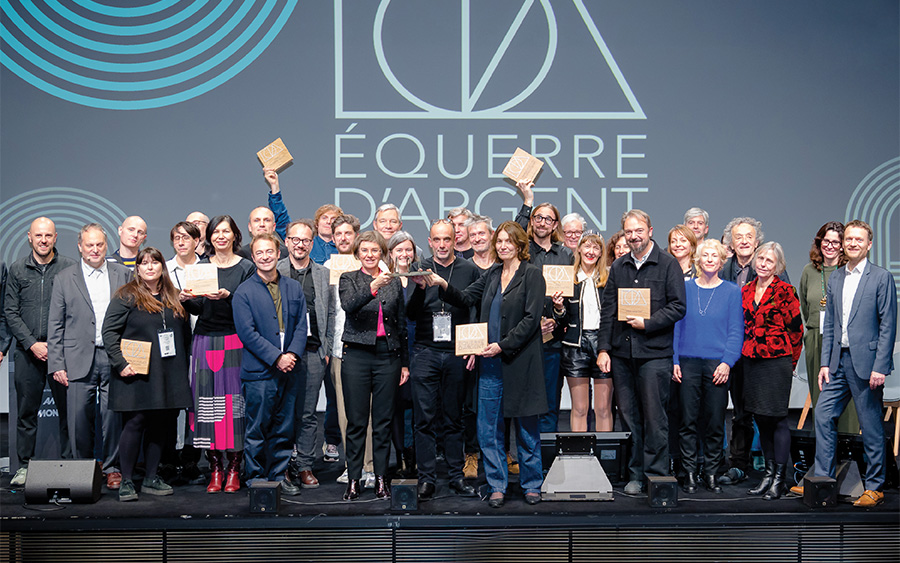
Since 1983, the Prix de l’Équerre d’Argent has honoured architectural works completed in France. With each building, it recognises both the client who commissioned it and the team that designed it. AMC and Le Moniteur, the publications that organise the award, announce the winners at a ceremony in Paris.
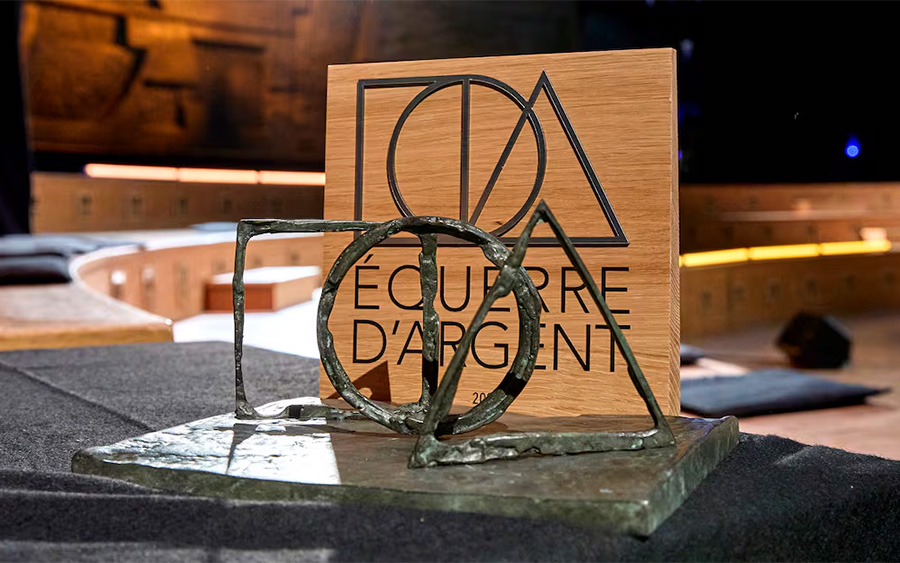
Since 1991, winners have received a bronze sculpture by Bruno Romeda. According to the Dutko gallery, this Italian sculptor worked with elementary shapes: the circle, the square and the triangle. He was also drawn to the ancient architecture of his country.
This article looks at the composition of the sculpture and what a win brings. It also draws lessons for brands that want to design their own trophy.
Contents
- Design and materials of the Équerre d’Argent trophy: elementary shapes in bronze
- What winning the Équerre d’Argent trophy brings
- The Simone-Veil school complex and its press coverage
- Giving a simple shape presence: lessons for brands
- Équerre d’Argent 2026: key dates
- Honouring buildings with bronze you can see through
- Frequently asked questions
Design and materials of the Équerre d’Argent trophy: elementary shapes in bronze
The sculpture turns three elementary shapes into volume: a square, a circle and a triangle, drawn as a frame, a ring and an open triangular profile. The Dutko gallery describes Romeda’s work as a threshold and a frame for the gaze, its tension lying in the roughness of the bronze.
The frame takes up the left of the composition, and the ring, to its right, overlaps it. The triangular profile closes the group on the right-hand side. All three elements are open, so the eye passes through them, and the piece rests on a square surface.
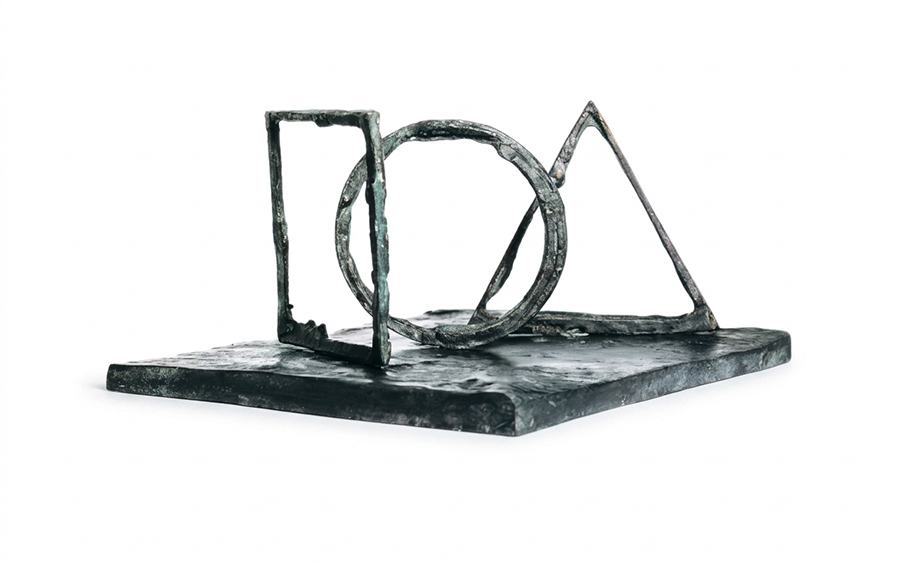
The bronze has an uneven, rough surface with a greenish-brown patina. The composition stays the same in every edition: those of 2020 and 2022 show it in flat profiles with sharp edges and a metallic finish.
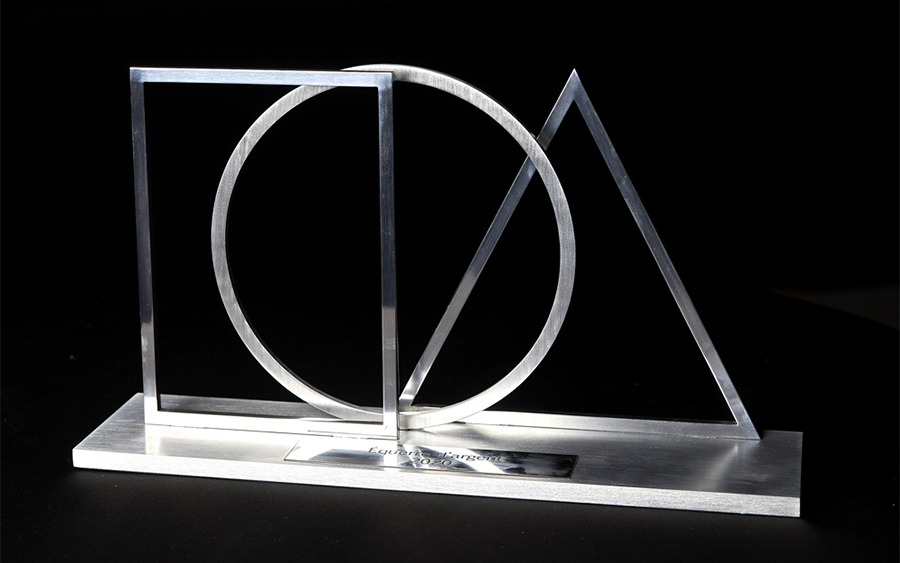
Taken together, three open elements let the space behind the piece show through, and the roughness of the bronze gives relief to its clean lines.
What winning the Équerre d’Argent trophy brings
An independent jury, chaired by an internationally renowned architect, chooses the winners by majority, with one vote per member. It assesses architectural quality, use, environmental qualities, energy and structural performance, and the relationship between client and team.
In 2026, the jury awards seven distinctions, among them the Équerre d’Argent, which is chosen from the nominees in five categories. The table below lists four of them.
| Distinction | What it recognises |
|---|---|
| Équerre d’Argent | Main award, chosen from five categories |
| Première Œuvre | First work by architects under 35 |
| Habitat | Housing projects |
| Espaces publics et paysagers | Public and landscape spaces |
Winning in any of them puts the work in front of a jury of architects and industry professionals. The benefits include:
- Use of the name and logo: the 2026 rules allow them in promotional documents for up to a year after the ceremony, which supports the winner’s proposals.
- Joint recognition: the award honours both the client and the project team, and both can present the building as an award-winning work.
- Publication of the results: AMC and Le Moniteur publicise the winners in
The Simone-Veil school complex and its press coverage
On 25 November 2025, Le Monde reported that the Simone-Veil school complex in Tremblay-en-France had won that year’s Équerre d’Argent. As a national daily, it reaches readers beyond the architecture press, who thereby discover the building and the award.
That coverage is what is known as earned media: visibility generated by a media outlet on its own initiative, which the winner does not pay for.
The same building reached other readers through outlets of a different scope. Notable examples include:
- Libération: the newspaper reported on 24 November 2025 that the prize had gone to the firm Le Penhuel & Associés, author of the project. It did so in its design section, which puts the work in front of readers interested in design.
- actu.fr: this local news portal published an article about the building in December 2025. The story makes the award known to the residents of Seine-Saint-Denis who use it.
For the firm, each article remains a public reference it can cite to new clients. For the town council of Tremblay-en-France, which commissioned the building, it is a recognition its residents can read for themselves.


Give your trophy a shape that is recognisable at a glance
Custom design, with care in every detail
Design your custom trophyGiving a simple shape presence: lessons for brands
When a brand starts from the basic shapes of the field it recognises, its trophy needs no explanation. The Équerre d’Argent illustrates this: the square, the circle and the triangle point back to the foundations of architecture. Whoever receives it identifies the field of the recognition at a glance.
In turn, when the surface has visible texture, a simple shape gains presence in photographs of the trophy. In the Équerre d’Argent, the roughness and patina of the bronze give relief to clean contours. A brand can choose the finish of its trophy so that it stands out in the images its winners share.
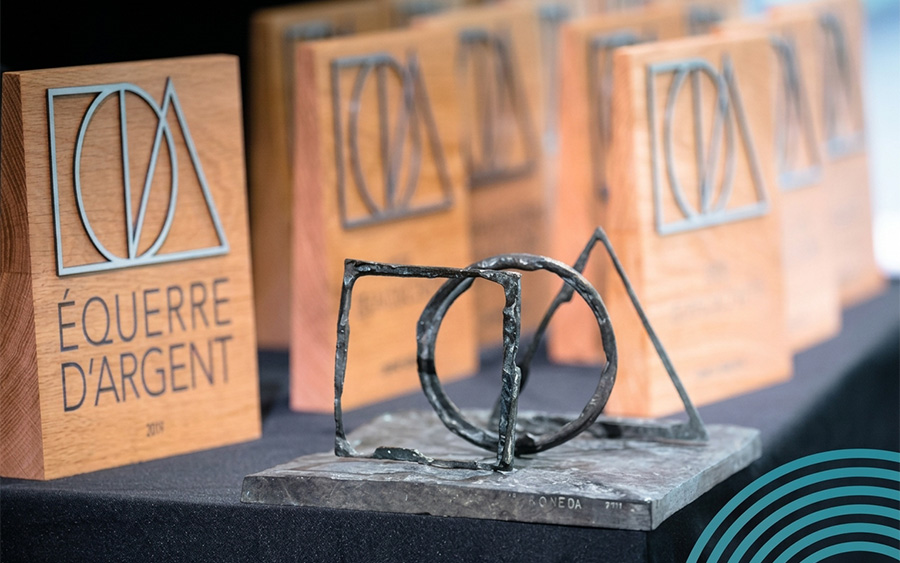
In this trophy, a simple geometry and a rough bronze answer to the same decision: that the form be recognised by its composition and stand out through its surface.
Équerre d’Argent 2026: key dates
The 44th edition brings together works delivered between 1 September 2025 and 31 August 2026. The award’s official website publishes its calendar.
- 21 September 2026: deadline for entries, extended from 7 September.
- 5 November: presentation of the nominees in all categories to the jury, in Paris.
- 23 November: presentation of the Première Œuvre nominees to the jury.
- 23 November: awards ceremony in Paris (provisional date).
- First working day after the ceremony: results published on the AMC and Le Moniteur websites.
Honour winners with a piece recognised by its shape and its surface
Custom design, with care in every detail
Design your custom trophyHonouring buildings with bronze you can see through
The Équerre d’Argent trophy turns three open shapes into a piece of rough bronze with a dark patina. With these elements, the sculpture represents what the award distinguishes: a building that brings together the person who commissions it and the person who designs it. Each winner thus receives an object whose openings frame the space behind it.
At Sustain Awards we design and make handcrafted custom trophies. If your brand starts from basic shapes, we can propose a textured surface that makes them stand out in every photograph of the trophy.