We are an industrial manufacturer of trophies, plaques, and medals. Our environmental impact, compared with emissions-intensive sectors, is small (but not zero). We don't use "sustainable" as a slogan: we'd rather tell you, material by material and process by process, exactly what we do and what we still need to improve.

Recycled materials

Part of our catalog incorporates recycled or reclaimed materials:

  • Recycled acrylic (methacrylate)
  • Post-consumer plastic
  • Recycled fishing nets
  • Rubber from end-of-life tires
  • Steel with a recycled fraction

The percentage of recycled material varies from model to model — it depends on each piece's manufacturing process, so we don't give a single figure here for the whole catalog (any general percentage would itself be a made-up figure). The exact material is listed on each product's own spec sheet, under "Composition." If a product page doesn't show that data, it means we haven't yet verified it for that model.

Third-party certifications and other logos on the site

To be precise: we do not hold any Type I third-party environmental certification (ISO 14024) — such as EU Ecolabel, FSC, or other equivalent schemes. The only independent third party involved in our environmental claims is Inèdit Innovació, S.L., which calculates the Life Cycle Assessment (LCA) of specific references under ISO 14040 methodology (see "What our 'Environmental Information' label is" below) — this is an independent technical calculation, not a product certification from a certifying body.

Additionally, other logos appear in the site footer that are not environmental certifications and should not be read as such:

  • "Made in Europe" (a manufacturing-origin claim, not an environmental one)
  • The "Funded by the European Union" logo and the Recovery, Transformation and Resilience Plan logo (mandatory when this type of public funding is received)

If these ever appear alongside a sustainability message in a way that could be mistaken for an environmental seal, that is a layout error that should be corrected — they certify nothing about the product's environmental impact.

Our beechwood comes from responsible sources, but we do not maintain an active Chain of Custody certification under any third-party forestry scheme — which is why we don't use any seal or the word "certified" in relation to wood anywhere on the site.

What our "Environmental Information" label is (and isn't)

Some product pages and category pages mention an "Environmental Information" label included with the order. We want to be precise about what this is:

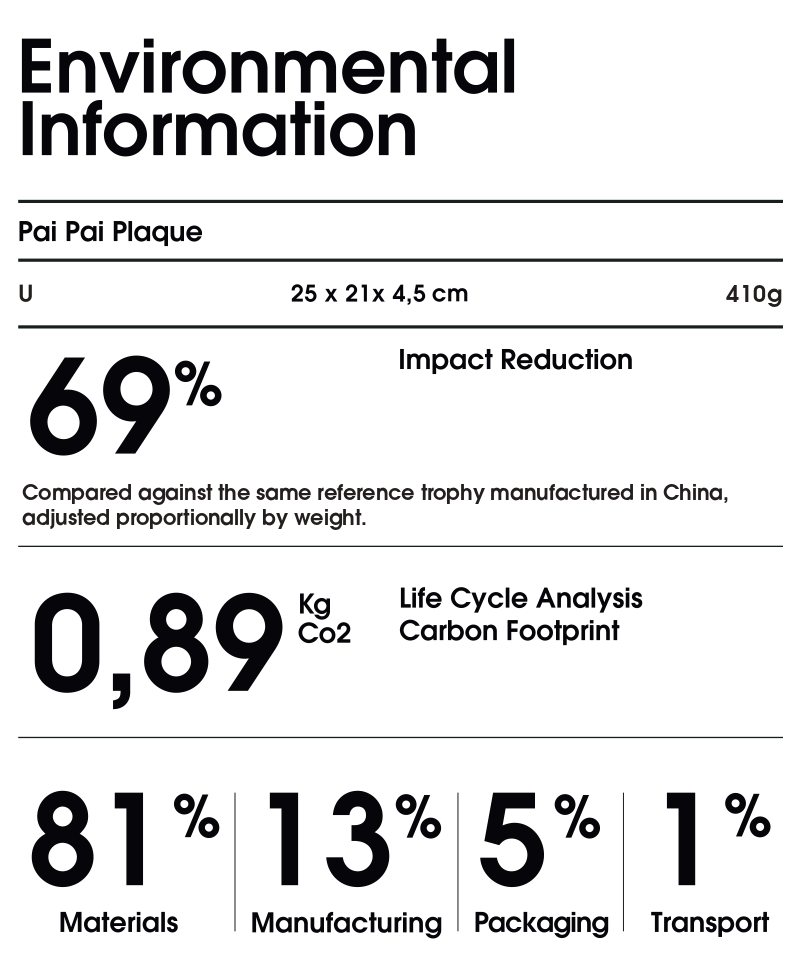
  • It is an in-house informational document (a self-declaration) whose calculation is independently verified by Inèdit — it is not a product certification from a third-party certifying body (see the Certifications section above: we hold no Type I certification).
  • The life cycle assessment (LCA) and carbon footprint calculation we mention on some product pages are carried out by Inèdit Innovació, S.L., an independent environmental consultancy, following the ISO 14040 methodology and the environmental inventory databases from Ecoinvent 3.10 (2024). These studies are product-level — for a specific reference or model — not a company-wide emissions accounting exercise. ISO 14040 is not a seal or certification on its own: it describes the calculation method used, and does not "certify" any percentage of reduction. If any page pairs the word "certifies" with ISO 14040, that is a wording error we are correcting.
  • The comparison is always made against the same reference trophy manufactured in China, weight-adjusted proportionally — this is the exact benchmark Inèdit uses and the only one that should be cited (never "a conventional trophy" or "an imported one" generically, without further detail). The impact reduction varies by model: among studies completed so far it ranges from 58% to 97% — there is no single figure valid for the whole catalog, and each figure may only be used on the spec sheet of the model it corresponds to.
  • Models that already have a completed Inèdit study include, on their own product page, the downloadable environmental information label (PDF) with its exact figure, the study, and the cited benchmark. If a product page doesn't include that downloadable label, it means that model doesn't yet have a completed Inèdit study — that page should not show any "% less CO2" figure until the label is available.

Our carbon footprint and how we offset it

Our first collaboration of this kind was in 2022, with Reforestum, in Calahorra de Boedo (Boedo-Ojeda region, north of Palencia), under an agreement with the Junta de Castilla y León. This initiative reforested an area of 250.19 m² and offset 5,000 kg of CO₂ (5 tonnes), a figure calculated by Reforestum based on our trophy production for that period. This was a one-time contribution, made prior to and independently of the current collaboration described below.

We partner with Life Terra (lifeterra.eu), a European forest restoration organization, on the Santa Clara-a-Velha I+II project in Portugal. It is part of a larger restoration of 65 hectares of previously degraded land invaded by eucalyptus, where more than 65,000 trees and shrubs have been planted.

Through this collaboration we have offset 12 tonnes of CO₂, by purchasing an initial batch of "Nature Positive Credits," which include biodiversity benefits at no extra cost. This is a one-time contribution — not an annual or recurring program over a set number of years. If we acquire new batches in the future, we will note that here with the corresponding date and figure.

You can verify this collaboration publicly at:

We also have the emissions removal certificate issued by Life Terra and the associated invoice, in the name of AK Digital Plastic S.L. You can request this documentation by writing to info@sustainawards.com.

This is why, elsewhere on the site, we do not use phrases like "we offset our annual emissions with forest cover." That phrase would imply total, recurring coverage of our emissions, and this specific action —a one-time 12-tonne contribution— is not that. The correct description, on any page that mentions it, is: "We partner with Life Terra on a certified reforestation project in Portugal, as part of our environmental commitment," linking here for the full detail. If we repeat or expand this collaboration in the future, we will update this page with the new date and figure before changing the message elsewhere on the site.

Finishes and toxicity

The painted finishes on our products use water-based paints, with reduced volatile organic compound (VOC) content compared with a conventional solvent-based paint.

Durability and quality

We take care with the finish and strength of every piece, but we don't use lifespan figures or durability guarantees we can't back up with testing. Phrases like "built to last" describe our design intent, not a measurement: they should not be read as a quantified guarantee of years of use.

Glossary: standards and methodologies we mention

  • ISO 14021 — standard for environmental self-declarations (Type II). We follow it as a best-practice guide when writing our own product pages, but following it is not the same as holding a third-party seal.
  • ISO 14024 — standard governing independently verified third-party ecolabels (Type I), such as EU Ecolabel or FSC. We hold no certification under this type of scheme; our only third-party involvement is Inèdit's LCA calculation under ISO 14040 (see above), which is a calculation methodology, not a Type I certification.
  • ISO 14040 / 14044 — Life Cycle Assessment (LCA) methodology. It is a way of calculating impacts, not a certification or a seal. We use it with Inèdit for specific product studies (see "What our 'Environmental Information' label is" above); any figure we cite "per ISO 14040" must come with the study, the exact reference, and the benchmark, or it should not be published.
  • GHG Protocol / ISO 14064 — greenhouse gas emissions accounting standards at the whole-company scale (corporate footprint). We do not currently use these. Our work with Inèdit is limited to life cycle assessment of specific references under ISO 14040 — not company-wide emissions accounting. That's why we do not state on any page that we have "our carbon footprint calculated" in a general sense: only the LCA of specific products exists.

Have questions about a specific claim?

If you see a sustainability claim on any page, social media post, or printed material that you don't find explained here in enough detail, write to us at info@sustainawards.com and we will provide supporting documentation or correct the claim if we cannot substantiate it.