Phone
 Email


- Trophies and sustainability
Design for Asia Awards Trophy: Two Planes, a Red Band and a Finish for Each Level
Since 2003, the DFA Design for Asia Awards have recognised design projects with an Asian perspective across six disciplines. The Hong Kong Design Centre (HKDC) organises them as its flagship programme, and a jury of professionals assesses every entry in two rounds.
The trophy was designed in 2015 by ECCO Design, an industrial design consultancy based in New York. ECCO Design says it took the shapes of the award’s initials as inspiration for the form.
Starting from that idea, this article looks at the trophy’s design and what winners receive. It also draws lessons for brands that want to design the trophy for their own award.
Contents
- Design and materials of the Design for Asia Awards trophy: two planes and a red band
- From Merit to Grand Award: what winners receive
- How the design press spreads the word about winners
- How to design a trophy that distinguishes levels without multiplying shapes
- Design for Asia Awards 2026: key dates
- The Design for Asia Awards trophy’s silhouette and its levels
- Frequently asked questions
Design and materials of the Design for Asia Awards trophy: two planes and a red band
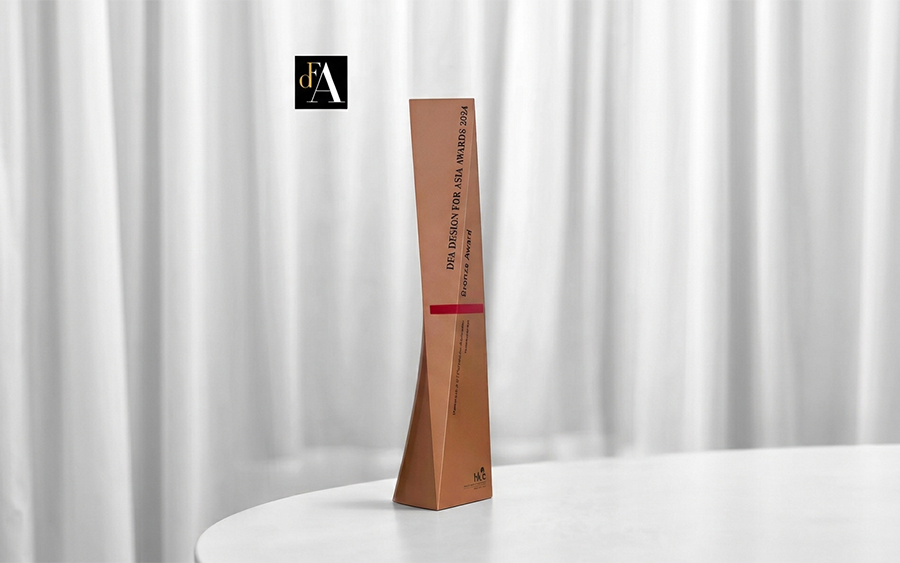
Taking the initials as a starting point, ECCO Design developed the trophy in three versions, one in gold, one in silver and one in bronze, and gave each version its own inlay, specific to its category.
The trophy is a slender form that widens towards the base and ends in a slanted top. Two planes meet along a diagonal edge that runs across the front face, and each plane catches the light differently. A red band crosses both at mid-height and breaks at that edge. The text for the level sits above the band and the text for the winning project below it.
The surface is matte, fine-grained and metallic in tone. The Bronze, Silver and Gold Awards are told apart by their bronze, silver and gold finishes.
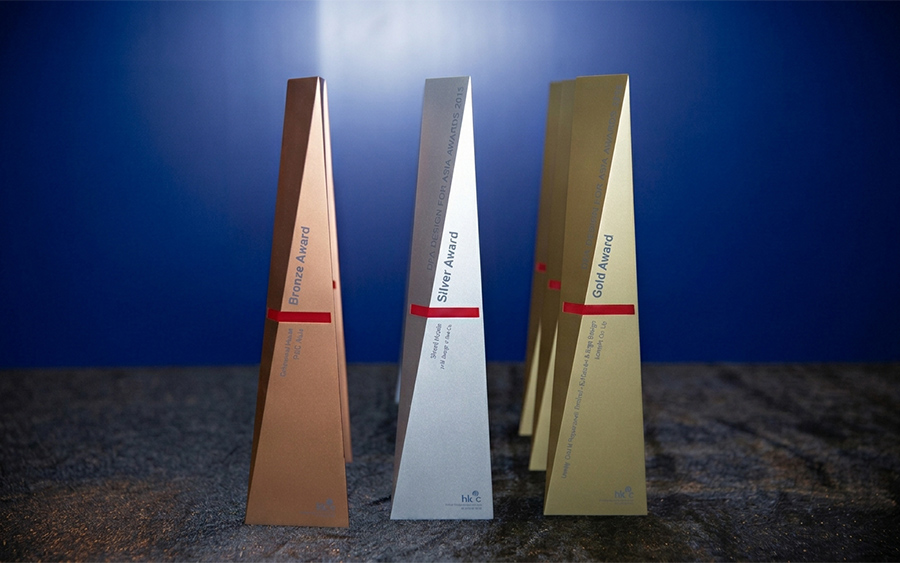
The finish changes from level to level and, on the graphite one, so does the band, as this table of four versions shows:
| Level | Finish and band |
|---|---|
| Bronze Award | Matte bronze, with red band |
| Silver Award | Matte silver, with red band |
| Gold Award | Matte gold, with red band |
| Grand Award with Special Mention (2018) | Graphite, with mirror-finish band |
The two planes and the diagonal edge stay the same across all levels; the finish shows which one has been won.
From Merit to Grand Award: what winners receive
A jury of design professionals with experience in Asia assesses every entry in two rounds. The first selects the Silver, Bronze and Merit Awards, and the final round picks the Gold and Grand Awards from among the finalists. Projects launched in Asian markets are eligible, submitted by their owner, client, brand, designer or consultancy.
In 2025, the jury granted 254 awards across five levels, and the Merit Award comes with a certificate instead of a trophy.
| Level | Who decides and how many (2025) |
|---|---|
| Grand Award | Final round among finalists: 10 |
| Gold Award | Final round among finalists: 20 |
| Silver and Bronze Award | First round: 46 and 72 |
| Merit Award | First round: 106 |
Winners receive a trophy and access to the HKDC’s promotional activities. The main ones are:
- Annual publication: the awards book features every project and the team behind it, giving the studio an editorial piece to show clients.
- Exhibition and online showcase: projects are displayed in exhibitions and on a web platform, which gives the work international visibility.
- Gala and Business of Design Week: the invitation lets winners meet local and international designers and executives, and opens doors to future commissions.
- Official badge: it authorises the use of the award’s endorsement mark in the project’s communications, which strengthens recognition among clients.
How the design press spreads the word about winners
In December 2023, designboom, an international architecture and design magazine, published a feature on that year’s Grand Award winners. They included a regenerative architecture building on a Japanese island, by tono Inc., and a robot vacuum cleaner with a mopping function, from Philips Domestic Appliances.
This type of coverage is known as earned media: exposure generated by independent outlets on their own editorial judgement.
For a winner, that feature puts the project in front of professional readers in the sector and potential clients, and gives it an external reference that backs up the award in their own portfolio. The feature also stays accessible online, so any client searching for the winner finds the distinction linked to their project.


Give each level of your award its own trophy
Custom design, every detail taken care of
Design your custom trophyHow to design a trophy that distinguishes levels without multiplying shapes
When a brand distinguishes several levels of recognition, a common silhouette with its own finish for each one keeps the collection together and lets the level be read in the colour. On the Design for Asia Awards trophy, bronze, silver and gold sit on the same two planes. As a result, a set of trophies photographed together is recognised as one series.
In turn, keeping that silhouette across editions makes the trophy a recognisable reference point. The award’s trophy has kept the same shape since 2015, and those of winners from different years are identified as part of the same award.
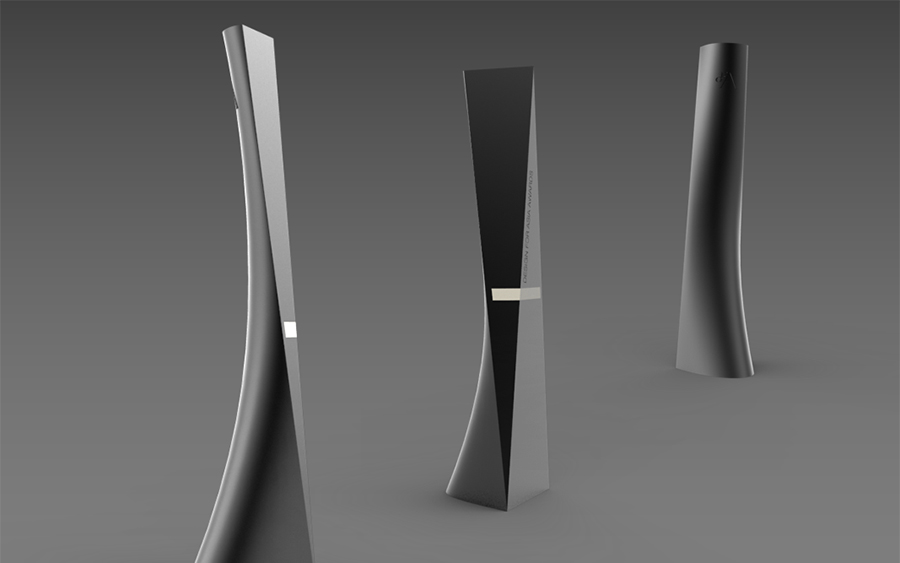
The two planes, the diagonal edge and the finish by level answer to a single decision: keep the silhouette and let the finish signal the level.
Design for Asia Awards 2026: key dates
For the 2026 edition, the Hong Kong Design Centre publishes the deadline and conditions of the call, with entries by invitation. The winners have already been announced and the gala coincides with Business of Design Week.
- 3 July 2026: entries close (5:00 pm, Hong Kong time).
- 15 October 2026: winners announced.
- 18 November 2026: awards gala.
Two planes, a band and a finish for each level: your brand’s trophy
Custom design, every detail taken care of
Design your custom trophyThe Design for Asia Awards trophy’s silhouette and its levels
The Design for Asia Awards trophy joins two planes along a diagonal edge, crosses them with a band and changes finish according to the level. In this way, the silhouette identifies the award and the colour shows which of its distinctions each project receives.
At Sustain Awards we design and manufacture custom trophies that distinguish your brand’s levels of recognition and keep the whole set together.