Phone
 Email


- Trophies and sustainability
The Dutch Design Awards Trophy: From Logo to Three Dimensions
Since 2003, the Dutch Design Awards have recognized the best of Dutch design. They are run by the Dutch Design Foundation, based in Eindhoven, which also organizes Dutch Design Week.
To renew the award's visual identity, the foundation turned to George&Harrison, a brand and design agency founded in Eindhoven in 2013. The studio builds visual systems in which color, typography, layout and imagery balance one another. Its brief included the physical trophy for 2020, which had to reflect the award's position: that of an institute that places Dutch design on a pedestal and in perspective.
Starting from that brief, this article looks at how the 2020 trophy turns the award's identity into an object. It also sets out the lessons it offers brands that want to design their own award.
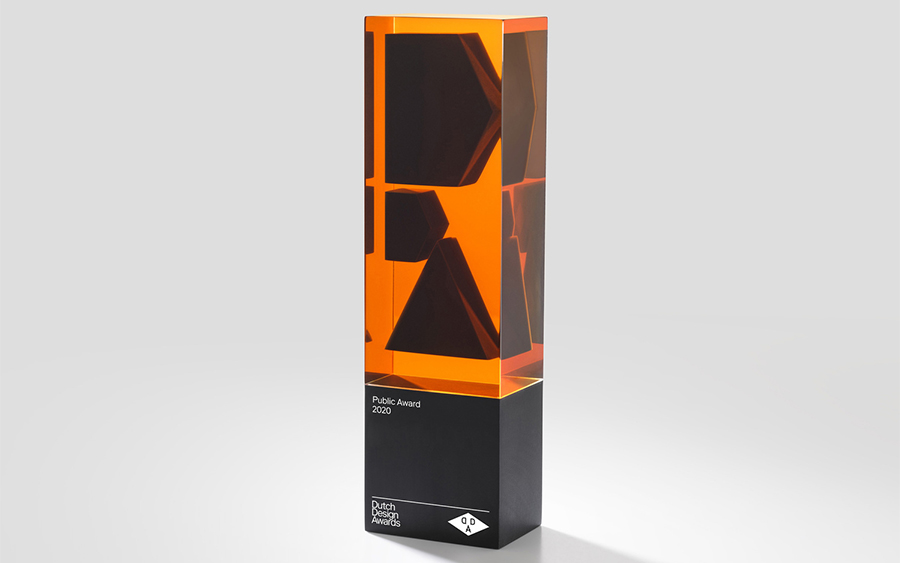
Image credits: George&Harrison
Contents
- Design and Materials of the Dutch Design Awards Trophy: An Orange Prism and Three Black Shapes
- Jury, Exhibition and Visibility: Winning a Dutch Design Awards Trophy
- The Press and the Dutch Design Awards Winners
- Identity in Three Dimensions: Lessons from the Dutch Design Awards Trophy
- Dutch Design Awards 2026: Key Dates
- Color, Shapes and Base: The Dutch Design Awards Trophy
- Frequently Asked Questions About the Dutch Design Awards Trophy
Design and Materials of the Dutch Design Awards Trophy: An Orange Prism and Three Black Shapes
George&Harrison set out to create a trophy that would be instantly recognizable as a 3D interpretation of the visual identity they had created. At the same time, it had to be intriguing as an object in its own right. The studio sums it up as a design without frills, monumental, with “a touch of magic and wonder.” That identity rests on geometric figures derived from the angles of the original logo and on orange as the main color.
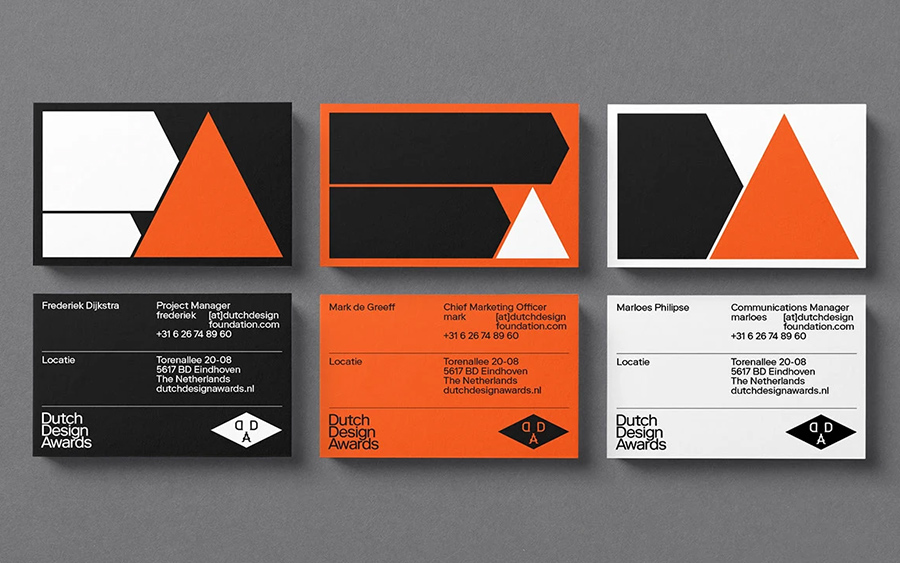
Image credits: George&Harrison
The trophy is a single piece shaped like a vertical prism, with flat faces and sharp edges. Its upper body, orange and translucent, encloses three black shapes aligned along the axis: two five-sided prisms, each with a pointed end, and a triangular prism beneath them. These shapes derive from the award's logo, and each face shows them in a different profile.
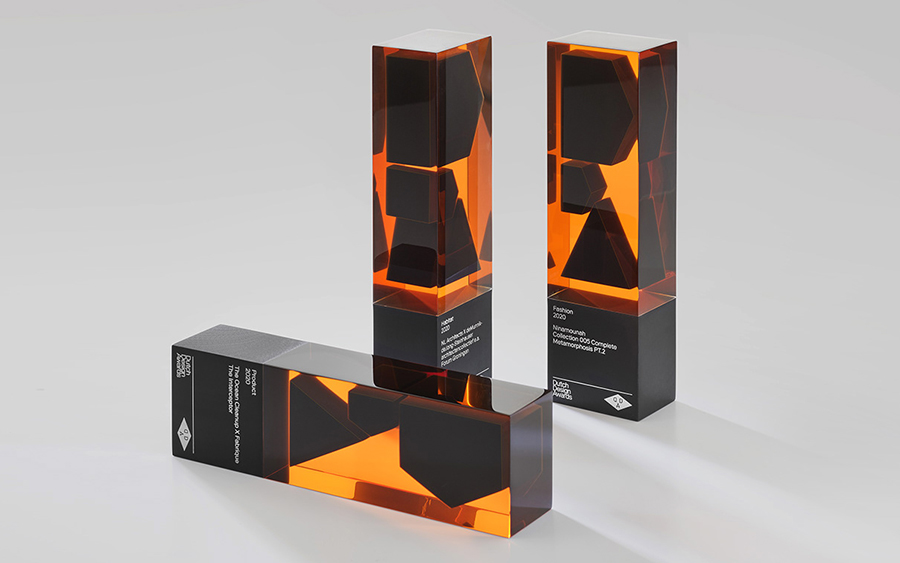
Image credits: George&Harrison
The base is matte black. On it, in white, the award's name, set in three lines, sits alongside its logo: a rhombus enclosing the letters DDA.
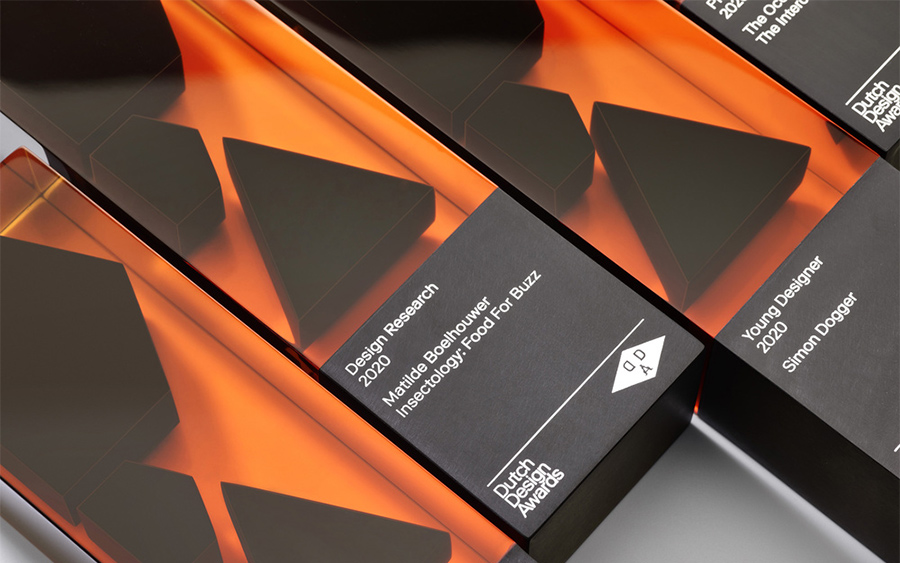
Image credits: George&Harrison
The S.T.R.S. workshop in Rotterdam made the trophy in polyester resin and epoxy resin. The translucent body lets light through, so the three shapes can be read from every side. The matte base absorbs light and closes off the block with an opaque volume.
The design is organized in three parts: color in the body, geometry inside it, and the black of the base as a finish.
Jury, Exhibition and Visibility: Winning a Dutch Design Awards Trophy
The jury applied four criteria: impact, distinctiveness, expressiveness and production method. The table below lists four of the eight categories of the 2020 edition.
| Category | Winner and project |
|---|---|
| Product | The Interceptor, by The Ocean Cleanup and Fabrique: a solar-powered river waste collector |
| Habitat | Forum Groningen, a cultural center by NL Architects and deMunnik-deJong-Steinhauser architectencollectief, among others |
| Fashion | Collection 005 Complete Metamorphosis PT.2, a collection by Ninamounah |
| Design Research | Insectology: Food For Buzz, research by Matilde Boelhouwer on feeding urban insects |
Winning in any of them puts the work in front of peers, press and public, and earns the jury's endorsement. The benefits of winning include:
- Prize money: in 2019 and 2020, the Keep an Eye Foundation awarded €12,000 to the Young Designer winner and €9,000 to each of the other two nominees, support for work that boosts the early years of a career.
- Exhibition: in 2019, a Dutch Design Week show brought together all the nominees and winners, bringing their work closer to peers and the public.
- Professional network: the award says it brings winners closer to the industry, opening paths to collaborators and clients.
- Online archive: it keeps projects since 2003, so a winner can point a new client to a public page about their work, and that searchable reference builds trust with someone who did not know them.

Image credits: Dutch Design Week
The Press and the Dutch Design Awards Winners
When a publication reports a winner's result, the award reaches readers who did not know their work. This is what is known as earned media: coverage a publication runs on its own initiative. The award makes it easier with the announcement of the winners and, in 2020, with a jury report and a press kit. Winners who have received it include:
- ByBorre Create (Product, 2021): Wallpaper* published the list of 2021 winners and presented the tool that Borre Akkersdijk, founder of the textile brand ByBorre, designed to simplify textile design. It thus reached readers of an international design magazine.
- The Interceptor and Water as Leverage (2020): the Dutch Water Sector platform reported on the awards for The Ocean Cleanup, with Fabrique, and for the Dutch government's Water as Leverage program. Both reached the water industry's audience.
- The Utopia Ball x Fashion Show (Fashion, 2022): FashionUnited reported that Yamuna Forzani won with this project, which combines a fashion show and a ballroom competition. The story introduced it to fashion professionals.
The piece fixes project and award in front of an audience from another sector, an endorsement the winner can cite to new clients.


Bring your brand identity into three dimensions
A trophy with your color, your shapes and your seal
Design your custom trophyIdentity in Three Dimensions: Lessons from the Dutch Design Awards Trophy
The 2020 trophy was designed as an extension of the brand rather than a separate object. That decision offers lessons that apply to other brands. Building the logo's shapes into the trophy brings coherence to all the graphic assets, because object and graphics read as a single whole. The three black shapes of this trophy show it: they derive from the logo, and the piece is recognizable in a photograph without needing to see the name.
This method gains reach when the inside of the trophy is conceived in three dimensions. In a translucent body, each face shows the shapes in a different profile and the brand is recognizable from any angle. That reading helps the piece spread when winners photograph and share it. The orange body, the three shapes inside and the black base answer to one decision: that the trophy belongs to the brand.
Dutch Design Awards 2026: Key Dates
The 2026 edition takes the form of the Emerging Talent Award. Established designers nominate emerging talents, and three winners receive €10,000 each, provided by the Keep an Eye Foundation. The official call for the Emerging Talent Award 2026 details the prize and the jury. Here are the dates:
- 31 March to 15 May: nominations.
- April: jury announcement, chaired by Borre Akkersdijk.
- 9 July: announcement of the fifteen finalists, who make up the 2026 class.
- 17 October: invitation-only ceremony at which the three winners are announced.
- 17 to 25 October: Dutch Design Week, in Eindhoven.
Color, Shapes and Base: The Dutch Design Awards Trophy
In the 2020 Dutch Design Awards trophy, orange provides the brand's color and the black shapes its geometry. The object is thus recognized as part of the award before a single letter is read.
When a brand's color and shape are part of the piece itself, the trophy communicates who is presenting it without any text to explain it. In our range of acrylic trophies we offer pieces in a variety of shapes, including personalized ones. We print the front and the back to add depth to the design of your trophy.
Turn your award into a work of art
Custom design, care in every detail
Design your custom trophyFrequently Asked Questions About the Dutch Design Awards Trophy
Related trophies